Maximizing Your 2026 Social Security Benefits: COLA Explained
Anúncios

2026 Social Security benefits increased by 2.8% through the official Cost-of-Living Adjustment, or COLA. The change is designed to help benefits keep pace with inflation.
The Social Security Administration officially confirmed the 2.8% increase in October 2025. Social Security beneficiaries began receiving the higher amounts with payments issued in January 2026.
Understanding the COLA, Medicare deductions, claiming age, taxes, and household benefit strategies can help beneficiaries make more informed retirement decisions throughout 2026.
Understanding the 2026 COLA Adjustment
The 2.8% COLA applies to Social Security and Supplemental Security Income benefits. It reflects the inflation measurement required under federal law.
The adjustment helps protect the purchasing power of beneficiaries as prices change. It affects retirees, survivors, people receiving disability benefits, and SSI recipients.
Anúncios
For anyone reviewing 2026 Social Security benefits, the important distinction is that 2.8% is now an official adjustment rather than a forecast.
How COLA is Calculated
The Social Security Administration calculates COLA using the Consumer Price Index for Urban Wage Earners and Clerical Workers, commonly called the CPI-W.
The calculation compares the average CPI-W for July, August, and September with the corresponding third-quarter average used for the previous COLA determination.
The CPI-W measures price changes experienced by urban wage earners and clerical workers.
COLA applies across Social Security benefit categories and to SSI payments.
The SSA generally announces the following year's COLA after third-quarter inflation data become available.
For 2026 Social Security benefits, that calculation produced an official increase of 2.8%.
Historical Context of COLA Adjustments
Automatic Social Security COLAs have been tied to inflation since the 1970s. Annual adjustments can therefore vary considerably from one year to another.
Periods of stronger inflation generally produce larger COLAs, while slower price growth produces smaller increases. The 2026 adjustment follows a 2.5% COLA for 2025.
Reviewing previous adjustments provides useful context for the 2026 increase without assuming that future COLAs will follow the same pattern.
Anúncios
Impact of the 2.8% COLA on Your Benefits
A 2.8% adjustment increases each beneficiary's applicable Social Security amount rather than adding the same dollar figure to every payment.
For example, a $1,500 monthly benefit would increase by approximately $42 before considering deductions or other adjustments, resulting in roughly $1,542.
The SSA estimated that the average retired-worker benefit would rise from about $2,015 to approximately $2,072 after the 2026 COLA.
Effect on Monthly Payments and Purchasing Power
The immediate effect of the COLA is a higher gross monthly Social Security benefit. The exact dollar increase depends on the beneficiary's existing amount.
The purpose of the adjustment is not to create an arbitrary bonus, but to help benefits retain purchasing power as consumer prices rise.
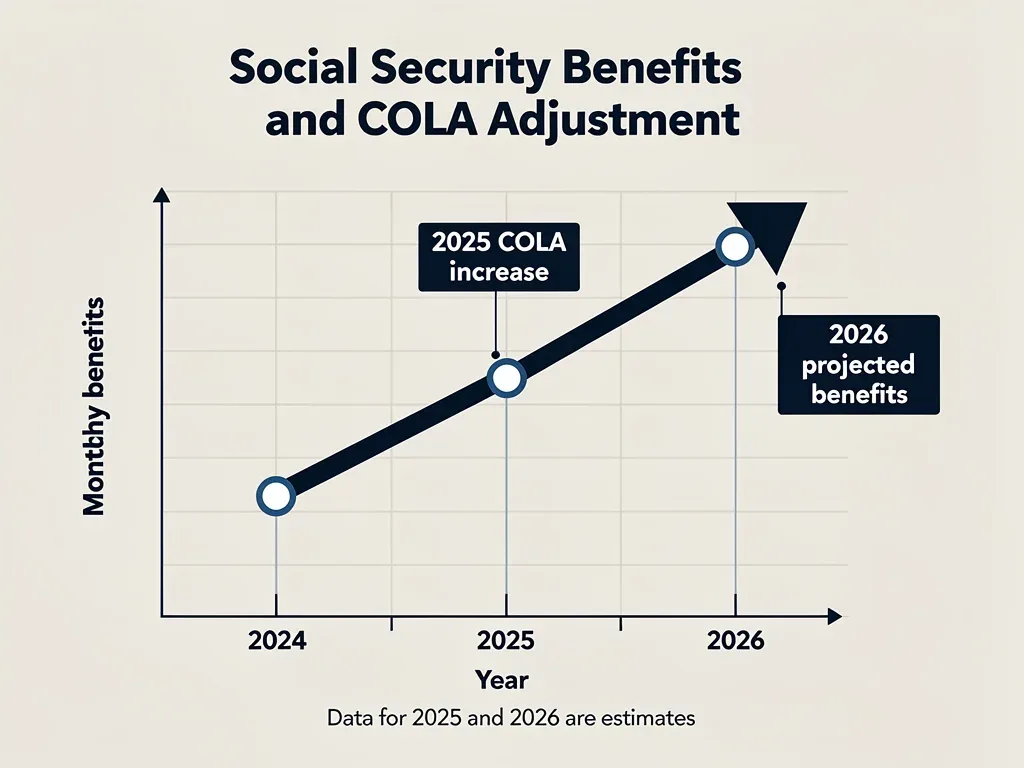
When evaluating 2026 Social Security benefits, beneficiaries should compare the gross increase with changes in healthcare and other household expenses.
Potential Medicare Premium Adjustments
Medicare Part B premiums can affect the amount of Social Security income that reaches a beneficiary because premiums are often deducted directly from monthly payments.
The standard Medicare Part B premium for 2026 is $202.90 per month, up from $185 in 2025. Higher-income beneficiaries may pay additional income-related amounts.
Medicare Part B premiums are determined separately from Social Security COLA.
The hold-harmless rule protects many beneficiaries from certain reductions in net Social Security payments.
Higher-income beneficiaries may pay Income-Related Monthly Adjustment Amounts, or IRMAA.
This interaction makes Medicare costs an important consideration when evaluating the real impact of 2026 Social Security benefits.
Strategies for Maximizing Your Social Security Benefits
The annual COLA is automatic, but claiming decisions can have a much larger effect on lifetime Social Security income. Claiming age is one of the most important variables.
Benefits can generally begin at age 62, but claiming before full retirement age reduces the monthly amount. Delaying can increase the monthly benefit.
Marital status, survivor eligibility, employment history, health, and other retirement income should also be considered when planning 2026 Social Security benefits.
Delaying Your Claim for Higher Benefits
Workers who delay claiming beyond full retirement age can earn delayed retirement credits until age 70. These credits can substantially increase monthly retirement benefits.
For many beneficiaries, delayed retirement credits increase benefits by approximately 8% per year between full retirement age and age 70.
Full Retirement Age depends on year of birth and is generally between ages 66 and 67.
Delayed retirement credits stop accumulating at age 70.
Health, employment, savings, and longevity expectations can influence the decision.
The right claiming age is individual, so maximizing 2026 Social Security benefits does not automatically mean everyone should wait until age 70.
Spousal and Survivor Benefit Optimization
Married couples may have access to both individual retirement benefits and spousal benefits. Coordinating claims can affect total household income.
A spouse may qualify for a benefit based partly on the other worker's record, subject to Social Security eligibility and claiming rules.
Survivor benefits also require careful planning because a surviving spouse may qualify for a payment based on the deceased worker's record.
Planning for Retirement with COLA in Mind
COLA should be incorporated into retirement planning as an inflation-adjustment mechanism rather than treated as guaranteed additional purchasing power.
Household expenses may rise differently from the CPI-W, especially when healthcare, housing, insurance, or other major costs change rapidly.
Planning around 2026 Social Security benefits therefore requires looking at total income and expenses rather than the COLA percentage alone.
Integrating COLA into Your Retirement Budget
Beneficiaries can begin by updating their monthly budget with the actual 2026 Social Security amount shown in their SSA records or COLA notice.
That amount can then be compared with pension income, investment withdrawals, employment earnings, and recurring household expenses.

A realistic budget makes it easier to understand how 2026 Social Security benefits fit into the broader retirement income plan.
Consulting with a Financial Advisor
Social Security decisions can interact with taxes, retirement accounts, Medicare, pensions, and family circumstances. These relationships can become complex.
A qualified financial professional can help compare claiming scenarios and explain how Social Security fits into a broader retirement strategy.
Beneficiaries should still confirm program-specific rules through the Social Security Administration because official eligibility and benefit determinations come from the SSA.
Legislative Landscape and Future Outlook
Social Security rules can change through federal legislation, but the 2.8% COLA applying to 2026 Social Security benefits is already established.
Separate discussions continue around the long-term finances of Social Security, including revenue, benefit formulas, retirement ages, and program solvency.
Future proposals should be distinguished from rules that are already in force. Beneficiaries should rely on enacted legislation and official SSA announcements when making decisions.
Potential Reforms and Their Impact
Policy proposals have included changes to retirement ages, payroll taxes, benefit formulas, and the inflation index used to calculate COLAs.
Another frequently discussed possibility is using a different consumer-price measure to better reflect the spending patterns of older Americans.
A different COLA formula could change future annual adjustments.
A change in Full Retirement Age could affect future claiming strategies.
Changes to payroll-tax rules could affect program revenue and covered earnings.
These proposals should not be treated as current rules unless legislation is actually enacted and implemented.
Economic Forecasts and Future COLA Projections
The 2.8% COLA affecting 2026 payments was calculated using actual CPI-W data and is no longer subject to revision as a projection.
The next COLA will depend on inflation data used for the subsequent annual calculation. Economic forecasts can estimate that figure but cannot determine it in advance.
Beneficiaries following future Social Security benefits should therefore distinguish between official SSA announcements and forecasts from analysts or financial organizations.
Navigating Tax Implications of Increased Benefits
Social Security benefits can be subject to federal income tax depending on a taxpayer's combined income. Receiving a higher benefit may affect that calculation.
Combined income generally includes adjusted gross income, tax-exempt interest, and one-half of Social Security benefits.
Tax effects should be considered when evaluating the net value of 2026 Social Security benefits, particularly for households with significant additional retirement income.
Federal Income Tax on Social Security
Federal taxation depends on filing status and combined income. Some beneficiaries owe no federal income tax on their Social Security, while others may have a portion included in taxable income.
Under longstanding federal thresholds, up to 50% or up to 85% of benefits may become taxable depending on combined income and filing status.
This does not mean beneficiaries pay an 85% tax rate on Social Security. It means up to 85% of the benefit can be included in income subject to applicable federal tax rates.
State Income Tax Considerations
State taxation of Social Security varies considerably and has changed in recent years. Some states exempt benefits entirely, while others apply specific income-based rules.
Because state laws can change, beneficiaries should check current guidance from their own state tax authority rather than relying on older lists of states that tax benefits.
Reviewing both federal and state rules can provide a clearer estimate of how much of 2026 Social Security benefits will remain after taxes.
Resources and Tools for Beneficiaries
The Social Security Administration remains the primary source for personalized and official Social Security information. Beneficiaries can access records and estimates online.
Financial planning calculators can complement official information by comparing retirement scenarios, but estimates should not be confused with SSA benefit determinations.
Using reliable resources can make decisions involving 2026 Social Security benefits easier to evaluate and reduce the risk of acting on outdated information.
Official Social Security Administration Resources
A “my Social Security” account can provide access to earnings records, benefit information, and other personalized Social Security services.
The SSA also publishes COLA factsheets, retirement information, eligibility guidance, and answers to common benefit questions.
Checking official resources is particularly important when confirming payment amounts, claiming rules, or changes affecting 2026 Social Security benefits.
Financial Planning Tools and Calculators
Retirement calculators can compare different claiming ages and illustrate how timing affects estimated monthly benefits.
These tools may also help model pensions, investment withdrawals, retirement spending, and other sources of household income.
Calculators are useful planning aids, but beneficiaries should verify actual benefit amounts and eligibility directly with the Social Security Administration.
Key Point | Brief Description |
|---|---|
2026 COLA | Official 2.8% increase in Social Security and SSI benefits for 2026. |
Benefit Impact | Monthly Social Security amounts increased to help offset inflation. |
Maximization Strategies | Claiming age, spousal coordination, survivor rules, and tax planning can affect retirement income. |
Retirement Planning | Social Security should be considered alongside Medicare, savings, taxes, and other retirement income. |
Frequently Asked Questions About 2026 Social Security Benefits
What is the 2026 COLA adjustment for Social Security?▼
The official 2026 Cost-of-Living Adjustment is 2.8%. Social Security beneficiaries began receiving the increase with benefits payable in January 2026.
How does the 2.8% COLA affect my monthly Social Security check?▼
Your applicable benefit amount increases by approximately 2.8% before considering Medicare premiums, taxes, or other deductions that may apply.
Can delaying my Social Security claim increase my benefit more than COLA?▼
Depending on your circumstances, delaying retirement benefits beyond Full Retirement Age can earn delayed retirement credits until age 70, increasing the monthly amount independently of annual COLAs.
What is the standard Medicare Part B premium in 2026?▼
The standard Medicare Part B monthly premium is $202.90 in 2026. Higher-income beneficiaries can pay larger amounts because of income-related adjustments.
What resources can help me understand my Social Security benefits?▼
The SSA website and a personal “my Social Security” account are the primary official resources for benefit records, estimates, COLA information, and program rules.
Looking Ahead: Navigating Your Social Security Future
The 2.8% adjustment is already part of 2026 Social Security benefits, making the focus now less about forecasting the increase and more about understanding its effect on household finances.
Medicare premiums, taxes, claiming decisions, and other retirement income can substantially influence how much money beneficiaries ultimately have available.
Long-term planning should therefore combine official Social Security information with broader retirement planning rather than relying on COLA alone.